Research Overview
Stay hungry, stay foolish.
— The Whole Earth Catalog
Project 1
Manufacturing of novel high temperature aluminum alloys through additive manufacturing cycle.(NSF)
Advancements 1:
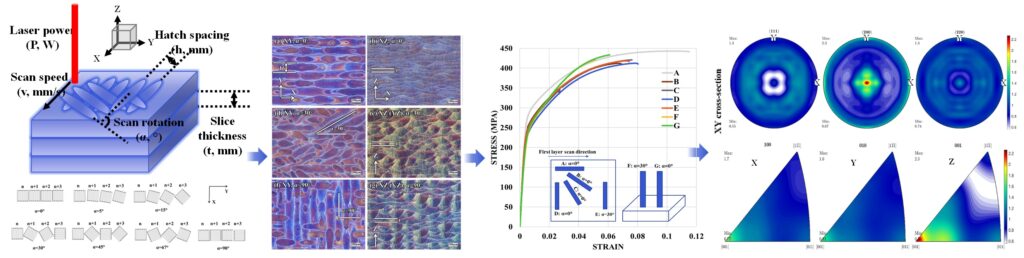
Le Zhou, Haijian Yang, et al. Controlling mechanical properties of laser powder bed fused AlSi10Mg through manipulation of laser scan rotation.
TL;DR: Controlling inter-layer laser scan rotation angles (α) in LPBF-fabricated AlSi10Mg alloy significantly enhances tensile performance, with α = 0° yielding a higher strength and improved ductility due to the alignment of melt pool boundaries with the loading direction.
Advancements 2:

Haijian Yang, Le Zhou, et al. Mechanical Property and Microstructure of Laser Powder Bed Fused Hypereutectic Al16Ce1Mg Alloy.
TL;DR: LPBF-processed hypereutectic Al16Ce1Mg alloy demonstrated exceptional printability, tensile strength, and creep resistance enabled by solid solution strengthening, dislocation hardening. Dynamic strain aging-induced PLC effects and Ce-depleted zone evolution governed its strain rate sensitivity and high-temperature deformation.
Advancements 3:

TL;DR: L-PBF processed eutectic Al10CeXZr alloys demonstrated excellent printability and enhanced mechanical properties, with Zr-induced grain refinement and precipitation strengthening achieved optimal performance, while statistical analysis identified fabrication method and heat treatment as the key factors governing ductility and strength.
Advancements 4:

Haijian Yang, Le Zhou, et al. Heat-Treatment-Driven Phase-Tailored Creep Strengthening of Laser Powder Bed Fused Ti-6Al-4V Alloy.
TL;DR: Wide-window compressive creep database was estalished for LPBF Ti-6Al-4V and linked HIP-based phase tailoring (HIP/HIP+aging/HIP+STA) and quantified α/β microstructural metrics to transition/threshold stresses, activation energy, and diffusion-assisted dislocation creep, establishing a mechanism-guided post-processing strategy to improve elevated-temperature creep resistance.
Advancements 5:

Haijian Yang, Le Zhou, et al. High Creep Resistance of Zirconium Modification of Laser Powder Bed Fused Eutectic Al-Ce Alloys.
TL;DR: A quantitative creep–microstructure strategy for LPBF Al-10Ce-xZr combines incremental-load creep tests, multiscale characterization, and mechanism-based modeling to decouple eutectic-network, grain-boundary transport, solute diffusivity, and precipitation thresholding, thereby providing design guidelines that balance grain size, phase architecture, diffusivity, and precipitate strengthening for improved elevated-temperature performance.
Advancements 6:

TL;DR: Modified with Ce and T6 heat treatment synergistically enhance the strength and fatigue resistance of A356 alloy through Al₁₁Ce₃ intermetallic formation and eutectic Si refinement, highlighting a tunable strength-ductility-fatigue balance in Ce-modified Al-Si cast alloys.
Project 2
Printing and Interface Engineering of Colloidal Nanocrystals for Flexible Thermoelectrics and Electronics (NSF)
Advancement:

Song K, Haijian Yang, et al. Machine learning-assisted 3D printing of thermoelectric materials of ultrahigh performances at room temperature.
TL;DR: A machine learning-assisted extrusion 3D printing strategy was developed to optimize ink formulations and process parameters, enabling the fabrication of complex-shaped BiSbTe-based thermoelectric materials; thermoelectric performance was further enhanced and electrical conductivity increased through HIP treatment by reducing porosity.
Project 3
Efficient cold-end heat release, cascaded waste heat utilization, and multi-cold source integration in Coal-fired power generation systems. (NKBRDP)
Advancements:
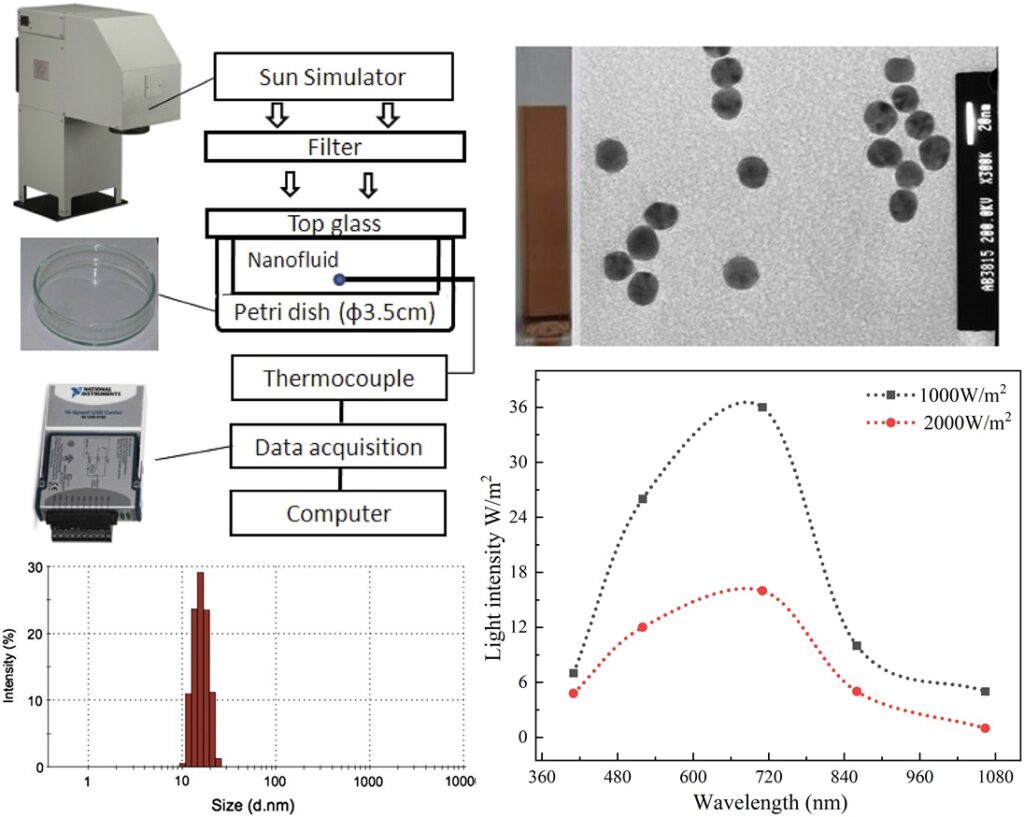
Hui Zhang, Haijian Yang, et al. Photothermal conversion characteristics of gold nanoparticles under different filter conditions.
TL;DR: Synthesized gold-nanoparticles exhibited high photothermal conversion efficiency and elevated specific absorption rates (SAR) under VIS-IR illumination, revealing critical property-spectrum relationships for nanoparticle-based thermal management applications.
Intelligent Additive Manufacturing System Platform Simulation
Simulations
Advancements 1:

Haijian Yang. Dislocation-mediated Plasticity and Discrete Dislocation Dynamics.(PDF)
TL;DR: Three-dimensional discrete dislocation dynamics (DDD) simulations using ParaDiS reveal the evolution of dislocation evolution under creep conditions, providing mechanistic insights into steady-state creep behavior and informing lifetime prediction models.
Advancements 2:
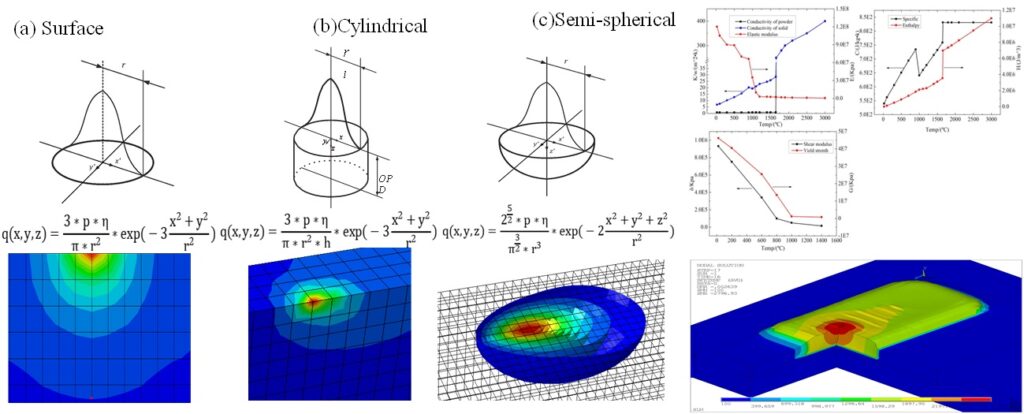
Haijian Yang. Macroscopic simulation and experimental measurement of melt pool temperature and stress distribution during selective laser melting of Ti-6Al-4V.(PDF)
TL;DR: Integrating experimentally validated Gaussian heat source modeling with temperature-dependent Ti6Al4V via 3D finite element framework quantitatively revealing the thermal-mechanical coupling behavior in selective laser melting (SLM).